

RV Covers. The Hidden Drawback Every RV Owner Should Know
Do RV Covers Actually Protect Your Roof?
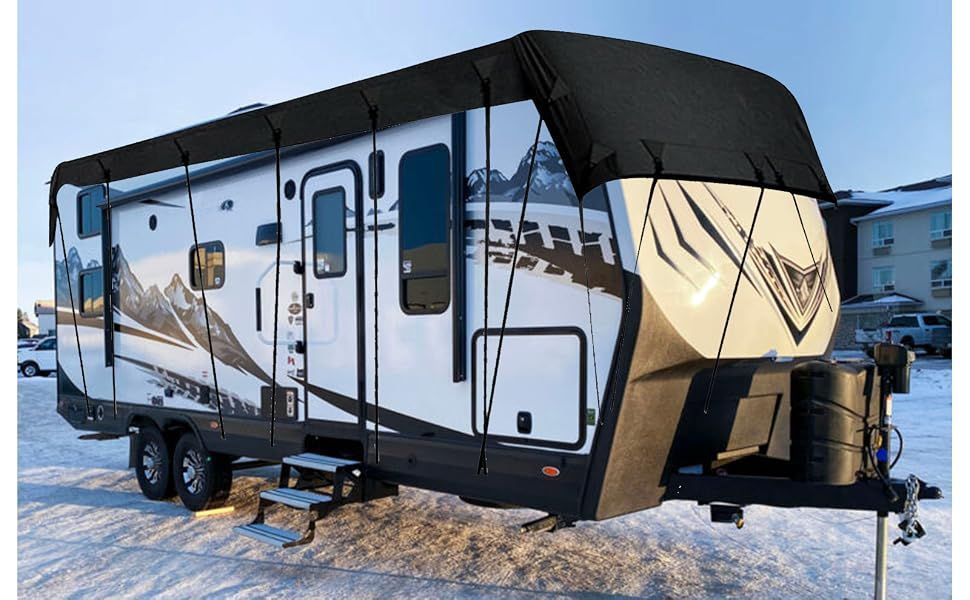
You've seen them in driveways & RV parks across the country. RVs wrapped tight in gray or blue covers, tucked away between camping seasons.
The idea makes sense on the surface. Cover it up, protect it from the elements, & your RV should be safe until your next adventure, right?
Not necessarily.
We know that some HOA regulations require you to cover your RV if you want to park it on your own property. We get it, rules are rules, and keeping your rig at home is important to a lot of RV owners. But before you wrap your investment in a cover and walk away, there are some critical things you need to understand about what that cover might actually be doing to your RV roof.
The Big Question is.... Do RV Covers Actually Protect Your Roof?
The short answer is: it depends. And in many cases, the answer is no. In fact, a poorly fitted, low quality, or improperly used RV cover can cause more damage to your roof than simply leaving your RV uncovered.
Here's what the RV cover industry doesn't always tell you.
The Hidden Drawbacks of RV Covers
1. Trapped Moisture Is Your Roof's Worst Enemy
One of the most significant and least talked about drawbacks of RV covers is moisture entrapment. When a cover is placed over your RV, it creates a sealed environment, and unless that cover is made from a truly breathable material, moisture from rain, condensation, morning dew, and even humidity gets trapped underneath.
That trapped moisture has nowhere to go. It sits against your roof membrane, works its way into seams and seals, and begins the slow process of deterioration.
What happens over time?
- Soft spots in your roof decking
- Seal and seam failure
- Delamination of interior walls and ceiling panels
- Mold and mildew growth inside your RV
- Rot in the underlying wood structure
The cruel irony is that many RV owners cover their rigs specifically to protect them from water... only to find that the cover itself created the moisture problem they were actually trying to avoid.
2. Cover Abrasion Damages Roof Membranes
Your RV roof membrane, whether it's EPDM rubber, TPO, or fiberglass (or another membrane), is designed to be durable, but it is not immune to constant friction. When wind moves your cover even slightly, it can easily create a constant rubbing action against the roof surface.
What happens over weeks and months of that friction?
- Wears down the protective surface of rubber and TPO roofs
- Creates micro-tears that allow water intrusion
- Strips away UV protective coatings on fiberglass roofs
- Accelerates the aging of your roof membrane far beyond normal wear
What can often start as a simple cover flapping in the breeze can ultimately shorten the lifespan of your roof by years.
3. Poor Fit Means Poor Protection
Not all RV covers are created equal, and fit matters enormously. A cover that is too large will billow, sag, and collect standing water in low spots, which can add significant weight and stress to your roof structure and create pools of moisture that seep through even the smallest gaps.
A cover that is too tight creates excessive tension across the roof, pulling at seams and edges and potentially lifting or compromising factory seals. Either way, an improperly fitted cover can do real structural damage over a single off-season.
A quick tip: a cover that looks like a great deal on Facebook Marketplace may not be one. If it isn't the right fit for your RV's length and model, or it isn't a quality, breathable cover, the savings can disappear really fast in roof repairs.
4. Covers Can Hide Developing Roof Problems
One of the most underrated dangers of keeping your RV covered for extended periods is that it prevents you from seeing what's happening to your roof. Small cracks, lifting seams, bubbling membrane, and early signs of water intrusion are all problems that are caught early through regular visual inspection.
When your RV is covered, those problems develop in the dark, often undetected, uninspected, and unchecked. By the time you pull the cover off in the spring, what could have been a minor repair has become a major restoration project.
5. UV Damage Is Real, But So Is the Alternative
One of the primary reasons RV owners use covers is to protect against UV ray damage, and that concern is legitimate. Prolonged UV exposure does degrade rubber roof membranes, fade fiberglass, and dry out seals over time.
However, the answer to UV protection is not necessarily a cover. A high quality roof system with UV protection built in, paired with regular roof maintenance and annual resealing of seams and vents, offers far superior UV protection without the moisture, abrasion, and inspection problems that covers introduce.
That's the thinking behind the complete roof system we install at RV Roofing Solutions. Instead of relying on a layer you have to put on and take off, UV protection is part of the roof itself, working every day whether a cover is on or not. And for owners who have to cover under an HOA, it means your roof isn't depending on the cover alone.
Isn't Any Cover Better Than Nothing in the Winter?
It's a fair question, and the honest answer is: not always. A quality, well-fitted, breathable cover can be a good choice. A cheap or loose one can be worse than leaving your RV bare, and winter makes that more likely.
Winter means condensation, snowmelt, and freeze-thaw cycles. A cover that doesn't breathe can hold that moisture against your roof for months, where it can work into seams and seals. A loose cover can also sag and hold water or snow in low spots, and winter wind keeps it rubbing against the membrane. And with the cover on all season, you won't see a problem until spring.
UV is lower in winter in many places (but not all), so what a cover mostly protects against then is debris, sap, and bird droppings. That's a smaller benefit to weigh against the moisture risk. If you do cover for winter, fit and breathability matter more than having a cover at all.
When an RV Cover Can Be a Good Option
In fairness, we're biased. We see the damage covers cause every season, so we tend to see the worst cases. But covers aren't always the wrong choice, and for some RV owners they're a real option worth considering.
When does a cover make sense?
- It's a quality, breathable cover. Multi-layer, RV-rated fabric lets moisture escape instead of trapping it.
- It fits your RV. It's sized for your RV's length and model, snug enough not to billow or sag, and not so tight that it strains seams and edges.
- It's secured well. Tie-downs and straps keep wind from moving it, which cuts down on abrasion.
- Your roof is in good shape first. The roof is clean and dry, with seals, seams, and vents inspected before the cover goes on.
- You check underneath. Pulling the cover off now and then to look at your roof means problems don't hide for months.
- The exposure justifies it. Long-term storage in a high-UV climate, or parking under trees where sap, debris, and bird droppings are a problem, are the situations where a good cover can earn its place.
- Your HOA requires it. Then a good cover is simply the right call, and the tips below will help you do it well.
The key is that a cover works best as a supplement to a healthy, well-protected roof, not a substitute for one.
So What Should You Do If Your HOA Requires a Cover?
If your HOA requires an RV cover to park on your property, how can you minimize the damage?
- Choose a breathable, high-quality cover. Look for covers specifically rated for RV use with multi-layer breathable fabric that allows moisture to escape. Avoid cheap single-layer polyester covers that trap moisture completely.
- Ensure proper fit. Invest in a cover that is sized specifically for your RV model and length. Use tie-down straps to prevent wind movement and abrasion.
- Add vent covers or air circulation panels. Some RV covers are designed with built-in ventilation panels that help reduce moisture buildup underneath.
- Inspect your roof before and after every cover period. Before you cover your RV, do a thorough roof inspection: check every seal, seam, vent, and edge. When you remove the cover, inspect again immediately. Catching problems early is everything.
- Maintain your roof proactively. A well-maintained roof with fresh seals and built-in UV protection, like a complete roof system, is far better equipped to handle the challenges a cover introduces.
RV covers are not inherently bad, but they are widely misunderstood.
Used incorrectly, they can cause the very damage they're meant to prevent. The RV cover industry sells peace of mind, but without proper selection, fit, and maintenance, that peace of mind can come at a significant cost to your roof.
At RV Roofing Solutions, we see the results of long-term cover damage every season. Moisture intrusion, membrane abrasion, hidden leaks, and delamination are among the most common issues we repair, and unfortunately, a significant number of them develop under a cover.
If you're concerned about the condition of your RV roof, or need guidance on the best way to protect your specific roof type during storage, we're here to help. We can also explain how a complete roof system with built-in UV protection could work for your rig.
Your roof is the most critical system on your RV. Protect it wisely.
Have questions about your RV roof?
With over 20 years in the RV roofing industry, we're a nationwide mobile RV roofing company with a process that has stood the test of time, and repairs can be built right into our complete roof system. That's why so many RVers choose us. Our technicians come to you. Contact RV Roofing Solutions today or visit our website to learn more, or call 888-847-7010 to get started.
You might also like
RV Roofing Solutions' Blog